Archaeology
"Giants of Stone"
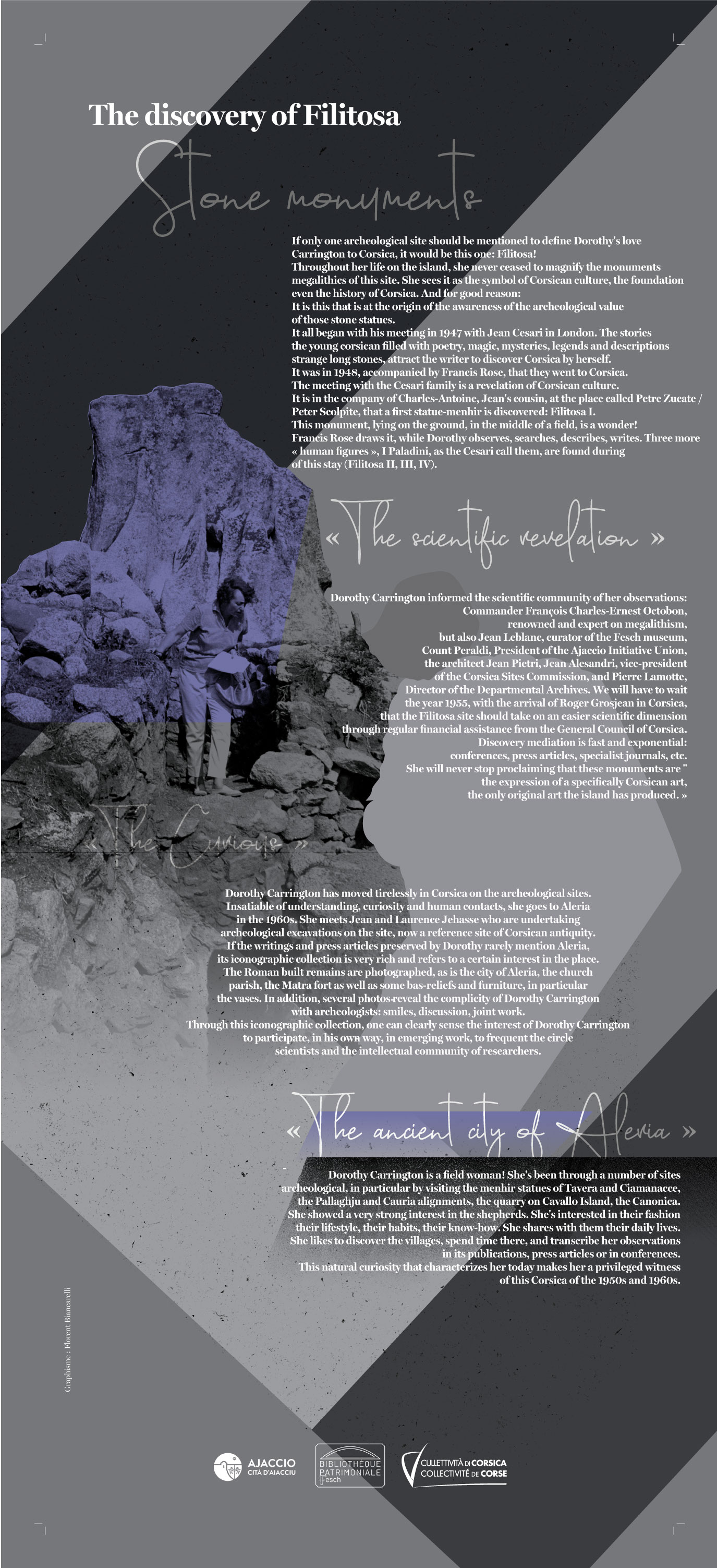
If only one archeological site could be cited to define Dorothy's love
Carrington to Corsica, it would be this one: Filitosa!
Throughout her life on the island, she never ceased to magnify the monuments
megalithics of this site. She sees it as the symbol of Corsican culture, the foundation
even the history of Corsica. And for good reason:
It is this that is at the origin of the awareness of the archeological value
of those stone statues.
It all began with his meeting in 1947 with Jean Cesari in London. The stories
the young corsican filled with poetry, magic, mysteries, legends and descriptions
strange long stones, attract the writer to discover Corsica by herself.
In 1948, accompanied by Francis Rose, they went to Corsica.
The meeting with the Cesari family is a revelation of Corsican culture.
It is in the company of Charles-Antoine, Jean's cousin, at the place called Petre Zucate /
Peter Scolpite, that a first statue-menhir is discovered: Filitosa I.
This monument, lying on the ground, in the middle of a field, is a wonder!
Francis Rose draws it, while Dorothy observes, searches, describes, writes. Three more
« human figures », I Paladini, as the Cesari call them, are found during
of this stay (Filitosa II, III, IV).
« The scientific revelation »
Dorothy Carrington informs the scientific community of her observations:
Commander François Charles-Ernest Octobon, renowned prehistorian and expert
on megalithism, but also Jean Leblanc, curator of the Fesch Museum, the Count
Peraldi, president of the Ajaccio initiative union, architect Jean Pietri,
Jean Alesandri, Vice-President of the Corsican Sites Commission,
and Pierre Lamotte, Director of the Departmental Archives.
It was not until 1955 that Roger Grosjean arrived in Corsica,
so that the Filitosa site takes on a scientific dimension facilitated by aid
regular financial of the General Council of Corsica. Mediation of discoveries
is fast and exponential: conferences, press articles, specialized journals,
etc. She will not cease to claim that these monuments are « the expression of an art
specifically corsica, the only original art that the island has produced. »
« The ancient city of Aleria »
Dorothy Carrington has moved tirelessly in Corsica on the archeological sites.
Insatiable of understanding, curiosity and human contacts, she goes to Aleria
in the 1960s. She meets Jean and Laurence Jehasse who are undertaking
archeological excavations on the site, now a reference site of Corsican antiquity.
If the writings and press articles preserved by Dorothy rarely mention Aleria,
its iconographic collection is very rich and refers to a certain interest in the place.
The Roman built remains are photographed, as is the city of Aleria, the church
parish, the Matra fort as well as some bas-reliefs and furniture, in particular
the vases.
In addition, several photos reveal the complicity of Dorothy Carrington
with archeologists: smiles, discussion, joint work.
Through this iconographic collection, one can clearly sense the interest of Dorothy Carrington
to participate, in his own way, in emerging work, to frequent the circle
scientists and the intellectual environment of researchers.
« The Curious »
Dorothy Carrington is a field woman! She's been through a number of sites
archeological, in particular by visiting the menhir statues of Tavera and Ciamanacce,
the Pallaghju and Cauria alignments, the quarry on Cavallo Island, the Canonica.
She showed a very strong interest in the shepherds. She's interested in their fashion
their lifestyle, their habits, their know-how. She shares with them their daily lives.
She likes to discover the villages, spend time there, and transcribe her observations
in its publications, press articles or in conferences.
This natural curiosity that characterizes her today makes her a privileged witness
of this Corsica of the 1950s and 1960s.
LRA My photos